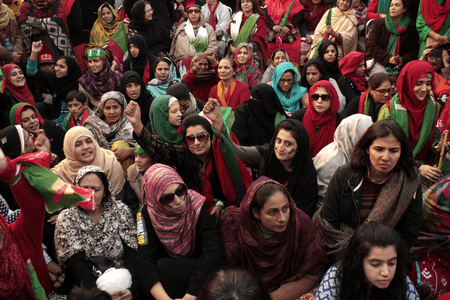
ISLAMABAD: The suppression of the Aurat March and other women's rights movements in Pakistan is driven by several ill factors infesting the country's socio-political structure, and exposes public dissent, the role of patriarchy and religion in controlling women, and the ground reality of constitutional freedom in the country, according to a report.
Earlier this year, Pakistani police used force against 75-year-old activist Sheema Kermani and detained her, sparking criticism from across the spectrum. Her only crime was that she wanted the Pakistan government to grant permission for the Aurat March, which is an annual peaceful event on feminism in Pakistan, according to a report in European Times.
"If Pakistan’s one of the most respected artists and women’s rights campaigners was subjected to such ill-treatment, one can just imagine the plight of women activists and protesters in the country. In the name of maintaining law and order, the Pakistani agencies stooped to the level of preventing Kermani from holding a press conference," the report said.
Police justified their action by saying that Kermani was just detained for a couple of hours. It may seem like a local dispute; however, it showcases the shrinking space for dissent, civil activism, and freedom of speech in Pakistan, especially when that activism is led by women.
Many women activists have highlighted how government agencies use different means to harass them in the name of law and public order. Women activists face online threats and harassment, disinformation campaigns, legal complaints, bureaucratic hindrances in getting permission to hold rallies, and physical attacks by pro-patriarchal activists. In addition, the Pakistani government has been actively working to curb the women's rights movement.
Patriarchy, which is deeply entrenched in the socio-religious character of Pakistan, seems to be the primary reason for imposing restrictions on women's movement. Women's demands in Pakistan for equal inheritance rights, freedom from domestic violence, reproductive autonomy, and the right to occupy public spaces without restrictions go against the patriarchal social order of the country, especially the bureaucracy, political class, and security establishment, which is mainly dominated by men.
"The suppression of the Aurat March and broader women's rights movements arises from the interaction of several ill-factors infesting Pakistani socio-political structure. Aurat March has become one of Pakistan’s most contested civil society movements, and it is gaining traction in the country, no matter how hard authorities try to suppress it. Ultimately, it has exposed the limits of public dissent, the role of patriarchy and religion in controlling women, and the real face of constitutional freedoms in contemporary Pakistan," the European Times report said.
In May, the Human Rights Commission of Pakistan (HRCP) condemned the detention of Aurat March organisers and volunteers outside the Karachi Press Club, where they had gathered to hold a press conference.
The rights body stated that preventing people from holding a press conference showcases an "increasingly repressive approach to governance", where dissent is considered a threat instead of a democratic necessity, Pakistani news network Geo News reported.
"HRCP strongly condemns the arrest of several organisers and volunteers of Aurat March from outside the Karachi Press Club, where they were scheduled to address a press conference.
This incident is not isolated overreach but rather part of a broader and deeply troubling pattern: the systematic denial of public space to citizens seeking to articulate their rights," HRCP posted on X.
"The rights to peaceful assembly and freedom of expression are constitutionally guaranteed. Preventing citizens, particularly women and marginalised groups, from even convening a press conference reflects an increasingly repressive approach to governance, where dissent is treated as a threat rather than a democratic necessity," it added.
--IANS