
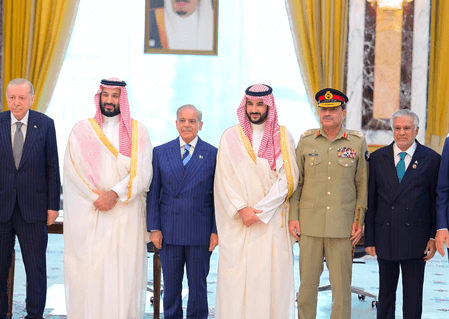
Ottawa, Aug 29 (IANS) The contradictions underpinning the Mecca Agreement involving Pakistan, Saudi Arabia and Turkey could hardly be more glaring.
With no shared values, common interests or even a unified threat perception, and no common adversary to bind them, the trilateral pact faces the fundamental question of what will ultimately hold it together, a report has highlighted.
“The Iran war is changing Middle Eastern geopolitics. US bases across the Gulf have been repeatedly targeted and the US has been unable to open the Strait of Hormuz fully for maritime traffic and energy shipments. This has prompted Middle Eastern countries to look at diversifying their defence partners away from Washington. The most visible demonstration of this evolving strategy came in early August when Saudi Arabia, Turkey, and Pakistan signed the Mecca Joint Defence Agreement,” a report in Canada-based 'Geopolitical Monitor' mentioned.
The Mecca Agreement is being promoted as a NATO-like security pact, with a provision similar to NATO’s Article 5 that considers an armed attack on any one of the three states an attack on all of them.
Highlighting the inherent contradiction in the Mecca Pact, the report said some members of the grouping have deep ties with adversaries of another. It asked whether Saudi Arabia, which has significantly strengthened ties with India over the past decade, would support Pakistan in a future conflict with New Delhi.
“In the past, Riyadh had asked Islamabad to send troops, ships, and aircraft for the war in Yemen. However, Pakistan’s parliament voted against joining the war. Each country considers questions of war and peace based on its national interests, and hence, there are apprehensions about whether the three countries will help each other or not. And even if they decide to help their fellow signatory, the extent of the assistance they provide remains an open question,” the report stated.
According to the report, NATO is the standard example of a successful military alliance, built on shared interests and common values. All its members are democracies committed to human rights and the rule of law, providing the alliance with a strong ideological glue. The Mecca Agreement, it said, by contrast, lacks any comparable binding political ideology.
“Saudi Arabia is a theocracy and seeks to maintain its position as the foremost Islamic state while launching internal reforms. Pakistan is a military-backed democracy. It deploys religion as a policy tool. Turkey is a strained democracy that champions the ideology of political Islam. Saudi Arabia believes that political Islam, especially the Muslim Brotherhood, poses a threat to its regime,” the report mentioned.
--IANS
scor/as