
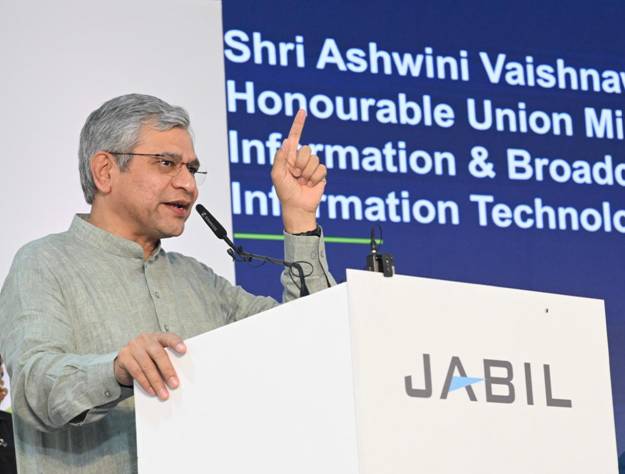
Union Minister for Electronics and Information Technology, Shri Ashwini Vaishnaw, along with the Chief Minister of Maharashtra, Shri Devendra Fadnavis inaugurated the high-tech Advanced Manufacturing Facility of Jabil Inc. at Ranjangaon, Pune on Wednesday, 17 June 2026.
Speaking on the occasion, Union Minister Shri Ashwini Vaishnaw highlighted how artificial intelligence has evolved into a powerhouse for global progress, stressing the strategic necessity of anchoring its infrastructure within the country. He emphasized that AI data centres have become a very large growth engine across the world today, making it a crucial priority under the Prime Minister’s Make in India plan to ensure that the major electronic components powering these data centres are manufactured domestically. Jabil will manufacture these crucial data centre components in Pune through their modern, advanced, and high-tech facility. Boasting an exceptional operational capacity, the plant is fully equipped to meet India’s domestic tech requirements while simultaneously driving exports to global markets across the world.
The Minister lauded the vision of Prime Minister Shri Narendra Modi in transforming electronics manufacturing into a premier pillar of the national economy. Thanks to these targeted initiatives, electronics manufacturing has surged forward to become the third-largest category among goods exported from India. This newly integrated ecosystem - encompassing electronic components, finished electronic goods, and local supply chains - is poised to unlock significant socio-economic benefits.
The Jabil facility is a state-of-the-art advanced electronics manufacturing setup specializing in cutting-edge technology infrastructure. Its operational capabilities include the complex manufacturing of AI Systems (AI-enabled Data Centre gears), 5G technology, high-end networking gears, industrial power system electronics, and consumer electronics.
The newly inaugurated high-tech facility possesses an extensive manufacturing footprint, equipped to meet domestic demand while serving global export markets. Backed by active policy cooperation, this project scales localized employment up to 11,000 personnel and will drive a deep localization program integrating domestic supply chains and MSMEs directly into the global technology ecosystem.