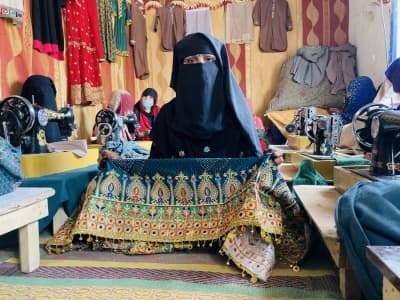
New Delhi, Aug 26 (IANS) Afghanistan's Taliban regime is facing mounting international pressure to remove restrictions on education and employment of women and girls, with several global bodies and countries calling for the removal of such bans even while providing humanitarian and infrastructural support.
Among other nations, India, while continuing to provide aid, has not officially recognised the Taliban administration and has been urging the formation of an inclusive government in Kabul, while insisting that Afghanistan must not be used for any terrorist activities against any country.
Recently, the first Afghan-American woman in the US House of Representatives has emphasised the need for "exercising diplomacy and having a relationship" for steering the regime "in the right direction when it comes to human rights, women’s rights" and other civil empowerments.
"As an Afghan American, someone who is proud of my culture and heritage, it’s disappointing to see what is happening in Afghanistan, where they are blocking women and children from going to school, really living their lives," Aisha Wahab told 'Democracy Now!' in a video interview.
"I think that that’s going to be a disaster to come for Afghanistan, let alone the fact that the United States needs to practice diplomacy. And regardless of which group is in power, we should be exercising diplomacy and having a relationship, hopefully even kind of steering them in the right direction when it comes to human rights, women’s rights and just civil rights across the board," she added, emphasising the need for diplomatic engagement towards this end.
California state lawmaker Aisha Wahab made history this month in a special election that will make her the first Afghan-American in Congress, the report said. The 39-year-old politician recounted her life, born in New York and raised in the US foster care system.
Her statement came around the time that a Taliban spokesperson told the BBC that issues of restrictions on women’s education and employment should be examined "through the lens of Sharia" and that decisions should be made on that basis.
Reiterating that they are "committed to women's rights, freedom of speech and other things within Sharia", he told the broadcaster: "We should see everything through the Sharia lens."
He added that the issue of education for women is "under discussions… we need a Sharia-based solution for it".
Meanwhile, according to separate reports, former President of Afghanistan Hamid Karzai has stated that girls’ education and women’s participation in the workforce are among key factors for his country to gain international legitimacy, hinting at a possible rethink among certain Kabul sections.
According to a Washington Institute policy analysis this month, "The Taliban has learned that it can reap substantial international rewards without budging on key security and human rights issues."
Yet, said the report, the US can still exert pressure on crucial soft spots such as UN credentialing, Treasury Department licensing, and Central Asian project financing.
Russia, it pointed out, "has taken the biggest diplomatic step" toward the Taliban by becoming the only country to formally recognise it in July 2025. In other countries, it added, as governments accepted Taliban-appointed diplomats, it took place without formally recognising the government.
Interestingly, "The map of Taliban outreach has been redrawn as well. Iran has displaced China as Kabul’s principal interlocutor, while Turkey, Qatar, and Uzbekistan anchor the tier below. India moved from token contact to the eighth-most-frequent diplomatic partner. Pakistan ran a complete cycle from patron to adversary, and Kabul now issues demarches to Islamabad the way any state would," the article noted.
Former allies Islamabad and Kabul – where the Taliban is said to have evolved largely out of a militia bred and trained in Pakistan – are involved in an intense battle, with the borders remaining closed for almost ten months.
--IANS
jb/vd